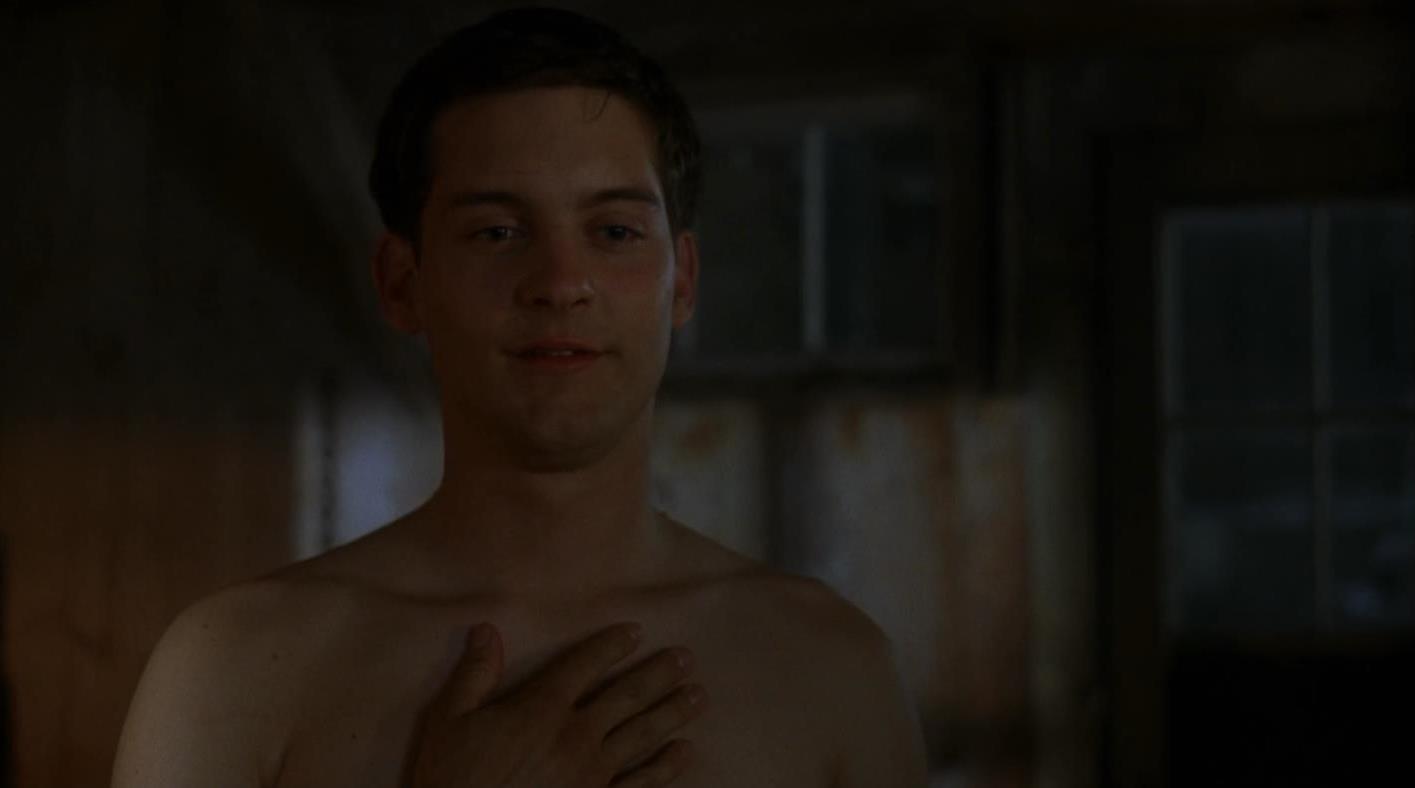
I first saw the film The World According To Garp in the early ‘80s when I was in high school. It was on HBO, and I watched it over and over again. It made a huge impression on me. In the late ’90s, I finally got around to reading the novel. I read several other books by John Irving after that, including The Cider House Rules. So I was excited when film version came out. I don’t normally go to the theater. I usually wait for movies to come out on DVD—or VHS tape back in the day—but in the spring of 2000, I had my father drive me to the nearby town of Beckley, West Virginia, so I could see The Cider House Rules on the big screen. I loved the movie, except the story felt rushed as compared to the novel. When I walked out of the theater, I can remember even now feeling a little cheated because it seemed the middle part of the story had been edited out. But I understand that movies are not mini series, and I really did enjoy the film a great deal. I especially liked Tobey Maguire as Homer Wells. He was so boyishly cute and sweet, and he seemed so befuddled and mystified by the world. His eyes always seemed to be filled with wonder, surprise and curiosity tinged with uncertainty and timidity. I fell in love with Tobey while watching this movie. I was 34, so I was still fairly young myself, but I knew my youth would soon be gone. I could feel middle age creeping up. I had already had my head surgeries. I had already been hospitalized for depression several times. I had already undergone electroshock. And I had basically given up and moved back home with my parents. Most of the time, I felt much older than 34, but there was still a spark of youth and hope inside me, and I felt it while watching Tobey’s young, pretty face and listening to his squeaky voice. How I longed for Tobey or someone like Tobey to come into my life. I watched The Cider House Rules again earlier, and I have to admit that I still love Tobey in this film. Fifteen years has passed, but watching young Tobey as Homer still fills me with longing. This screenshot shows Homer admiring Candy who is stretched out naked on his cot in the bunkhouse. Homer tells her that she is so beautiful to him that it hurts. I know just what he means.
I like to think this is a still from a recently rediscovered film from the ‘60s that was never released because of its subject matter. It’s about a shy young college student named Max who loses his cool summer intern job in the city at the last minute and has to spend the next three months with his grandmother. The grandmother lives in an isolated seaside village in Maine, and she has offered to pay Max to do yard work. The boy is quite depressed and lonely until he meets an odd young man of about the same age in the local cemetery. Max is usually awkward around strangers, but much to his surprise, he feels completely at ease with Philip…even though Philip is preoccupied with death and frequently speaks of ghosts. Philip begins taking Max on tours of supposedly haunted locations in town. Philip taxes Max’s patience with his maudlin theatrics, and the two boys quarrel. Philip finally admits that he doesn’t really believe in ghosts, but he wants to believe because he can’t bear the thought that death is truly the end. On his last night in town, Philip talks Max into breaking into the deserted Drake mansion, a huge Queen Anne Victorian that sits on a high bluff overlooking the Atlantic. Philip explains that the Drakes died in an accident the year before. The house is empty except for a baby grand piano in the front parlor. Philip never mentioned having any musical abilities, but that evening, he sits down at the piano and plays the most beautiful and melancholic sonata Max has ever heard. The boys admit they are attracted to one another and make love for the first time. Afterwards, Max notices that Philip has become a little sad and asks him what’s wrong. Philip says he was thinking about Max going back to school. Max promises to come visit Philip the first chance he gets. Philip thanks Max and gives him a kiss, but he doesn’t seem to really believe they will see one another again. The boys decide to sleep there in the Drake mansion, so they hold onto one another and grow silent. Just as Max is about to drift off, Philip tells him in a strangely urgent voice that life is short and that he can’t let anything or anyone hold him back. He makes Max swear that he’ll make the most out of his life. The next morning, Max wakes up alone. Philip is not to be found, so Max returns to his grandmother’s house. The grandmother is upset, but Max apologizes and explains he spent the night with a friend. Since Max is about to leave, the grandmother lets it go and asks Max in a calmer voice where he was. Max tells her he was in the Drake mansion. The grandmother tells him it was tragic what happened to the Drakes the summer before. Their breaks went out, and their car went over the bluff. Their son was with them, a prodigy who had been accepted at Juilliard. Max asked what the son’s name was. Philip, his grandmother said.
In May 1994, I was hospitalized for depression and suicidal ideation. While in the hospital, no one asked me anything about my sexuality. The doctors and the nurses didn’t ask me anything about it in private. They didn’t ask me if I was seeing anyone or how long it had been sense I had gone on a date or had another human being touch me in an intimate way. The doctor and therapist I saw as an outpatient asked me about such things regularly, but going into the hospital was like going into the closet. I was assigned to the unit for survivors of childhood trauma, and we spent much of the day in group therapy. The other straight members were encouraged to go into detail about their private lives and their past traumatic experiences. But no one asked me about my private life, and I wasn’t asked to describe what it was like growing up in a homophobic environment, even though that was a significant part of the trauma I had survived. Everybody carefully avoided the topic…except one intern. One day this intern was interviewing me alone in my room, and he declared that I had become a homosexual after failing at being a heterosexual. I quickly informed him that I had never been a heterosexual, and that being gay had nothing to do with striking out with the girls. I was a desperate young man, and I had turned to these so-called professionals for help, but I quickly realized that they were not ready to face my reality. It reminded me of having to work around my mother’s psychosis when I was growing up…the other significant part of the trauma that I had survived. My mother at least had an excuse. She had a serious mental illness that caused her break with reality. A couple of years ago, I shared this story on Facebook, and someone who obviously wanted to express sympathy said that my encounter with the intern illustrated why we should be careful about what we say because those who hear us might remember what we tell them for years. Well, yes, but that was hardly the point. I didn’t share the story because a stupid comment still hurt years later. The intern wasn’t an indelicate, rude stranger that I had come across by chance. The intern was a paid professional who was supposed to be helping me stay alive. Instead, he was just one more person who didn’t understand. Having to face this level of ignorance and lack of compassion was one of the reasons I was so uncomfortable around others.
The film Carol is scheduled to come out in November, so I’ve not seen it, but I am looking forward to it. It is based on the novel The Price of Salt by Patricia Highsmith, the same author who wrote Strangers on a Train and The Talented Mr. Ripley. I recommend the novel. Highsmith has a simple prose style, but with everyday language and relatively short sentences, she manages to evoke vivid images and feelings. Therese is a young woman of 19 and just starting her adult life in early 1950s New York. She works in a department store and is dating a young man named Richard. One day in December, Therese sees an older woman doing some Christmas shopping in the store. Therese is instantly drawn to the woman, and she ends up waiting on her. The woman wants her packages delivered, so she fills out a form with her name and address. Therese goes so far as to copy the address and sends Carol a Christmas card. It’s an odd thing to do, but it leads to the two women meeting and getting to know one another. Therese experiences intense longing for the woman, but she’s young, and it’s the 1950s, so she doesn’t understand that she’s attracted and falling in love.
I'm a randy little devil. I can remember standing on the steps in front of the student union at WVU in the middle of the day when thousands of young men were heading to their next class, and it was just a little bit of heaven for me. I wanted them all, and in my imagination, I had them all. In my head, I'm a wild and crazy guy. And that has not changed as I've gotten older.
But I also have PTSD and extreme social phobia. It's hard for me to ask someone what time it is, much less ask a stranger for sex. And my discomfort around others is super obvious. People know they make me uncomfortable, so most of the time, they keep their distance. Back when I had one night stands, it was sometimes difficult for me to climax because I couldn't relax. It's hard to have an orgasm if your body is reacting as if you're under threat of an immediate deadly attack. I remember one partner stopping and saying, "You look terrified. It's like you'd rather be anyplace else but here." Well, he was right, but it wasn't anything personal. He was a cute and adorable boy. I wanted to have sex with him, but I couldn't relax.
I don’t know if there’s a god or not, but I’m open to the idea that there is a spiritual, transcendent reality and that our awareness and understanding of it is ineffable and beyond the scope of science and ordinary sensory perception. However, I find the belief in supernatural beings like Satan with malevolent human-like personalities to be primitive and absurd. Satan is the grownup version of our childhood bogeyman. He is the personification of our fear, a convenient excuse for our misdeeds and a means to bully others. I have little patience for those who threaten us with the idea of Satan or hellfire.
We’re all individuals. But the gay men as effeminate thing… I don’t think that’s so horrible. I think it’s far more bothersome that so many believe there’s something wrong with being an effeminate man, and I think it’s sad that many gay men are so terrified of being thought of as effeminate that they put themselves down and attack other gay men for not being masculine enough.